Case Study
AI Booking Inquiry Intake & Alert Workflow
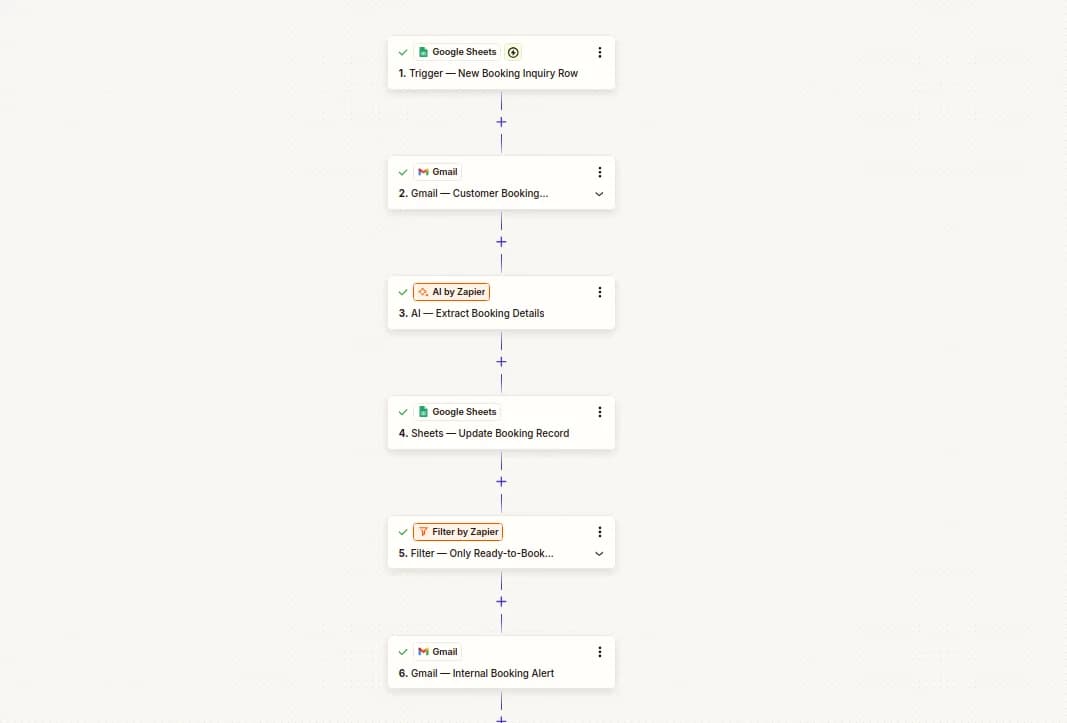
AI-powered Zapier workflow that captures booking inquiries, extracts scheduling details, and alerts the team when inquiries are ready to schedule.
THE HOOK
Service businesses live and die by response speed. A booking inquiry that sits unread for hours is a booking that goes to a competitor. Yet most small and mid-sized service operations still review inquiries manually — scrolling through form submissions, decoding vague messages, deciding who follows up and when.
The cost is not just lost bookings. It is operational drag. Team members context-switching into review mode. Schedulers guessing at intent. Owners wondering whether anyone saw that urgent request from yesterday.
THE DIAGNOSIS
This was not a staffing problem. It was a systems gap.
Booking inquiries arrived through a Google Form, landed in a Google Sheet, and then waited for a human to read, interpret, and act. No classification. No prioritization. No alerting. The same person who handled scheduling also had to manually scan every row, extract key details from free-form text, and decide what to do next.
The process broke down in three ways:
1. Delayed review — Inquiries accumulated before anyone checked the sheet. 2. Ambiguous intent — Free-form submissions required mental parsing to understand what the customer actually wanted. 3. Missed urgency — High-intent, ready-to-schedule requests sat alongside general questions with no visual or automated distinction.
THE THESIS
Manual review does not scale. Neither does it need to.
The opportunity: build a lightweight automation layer that captures every inquiry, uses AI to extract structured scheduling intelligence, enriches the original spreadsheet record, and alerts the team only when an inquiry is ready for action. No new software. No complex infrastructure. Just smart routing between tools the business already uses.
THE BUILD
— Google Form as the intake front door. Clean, accessible, zero friction. — Google Sheets as the system of record. One row per inquiry, timestamped and traceable. — AI by Zapier as the extraction engine. Structured ...
Project Gallery