Case Study
Hermes + Obsidian AI Second Brain System
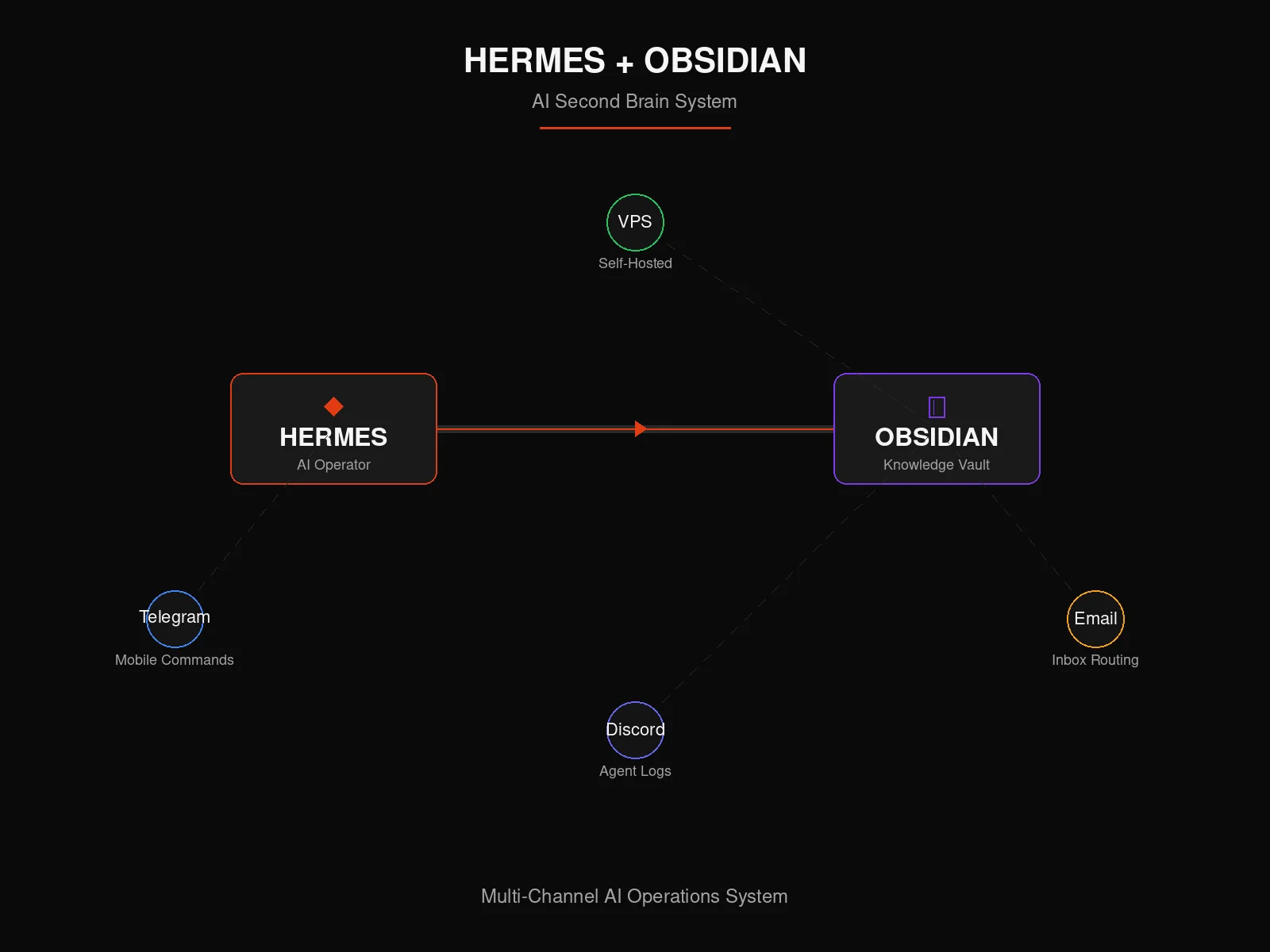
A self-hosted AI operations system using Hermes, Obsidian, VPS infrastructure, Telegram, Discord, and email workflows to organize knowledge, tasks, reminders, prompts, and agent outputs across devices.
THE HOOK
Most people treat AI as a chatbot. I treat it as an operating layer.
The difference is not technical sophistication. It is structural thinking. A chatbot answers questions one at a time. An operating layer captures, routes, retrieves, and acts on information across the tools you already use.
I built Hermes + Obsidian AI Second Brain because my work was scattered across too many channels: business strategy notes in one app, career applications in another, coding prompts in a third, daily reminders in a fourth, and agent outputs lost in browser tabs. Information was being created faster than it could be organized. Context was being lost between sessions. And the most valuable asset I was building — a library of prompts, workflows, and structured knowledge — had no central home.
The opportunity was not to find a better note-taking app. It was to design a personal AI operations system that turns scattered information into structured, retrievable, and actionable knowledge.
THE DIAGNOSIS
The problem was not storage. It was operational continuity.
My work spanned several domains: business operations, career applications, automation planning, coding prompts, client opportunities, job search workflows, and personal productivity. Each domain generated notes, tasks, ideas, and reminders through different channels.
The friction showed up in four ways:
1. Capture fragmentation — Information arrived through Telegram, Discord, email, AI chats, browser tabs, and local files. Each channel held a partial picture. 2. Context loss — A prompt I wrote on Monday was buried by Wednesday. A task I captured on mobile never made it to my desktop workflow. 3. Retrieval failure — When I needed a previous note, prompt, or plan, I could not find it quickly enough to be useful. 4. Manual overhead — Moving information between apps consumed more time than acting on it.
The real cost was not inconvenience. It was compounded inefficiency. Every context switch, every lost note, every repeated search added friction to work that needed to flow.
THE THESIS
A second brain is only useful if it is connected to the channels where work actually happens.
The opportunity: design a self-hosted AI operations system that combines Hermes as the AI operator, Obsidian as the structured knowledge vault, and a VPS as the infrastructure backbone. Then connect Telegram, Discord, and email as input and notification channels so the system meets me where I already work.
The principle: capture anywhere, organize centrally, retrieve instantly, act immediately.
This is not about collecting more notes. It is about building a knowledge system that supports decision-making, workflow execution, and long-term learning.
THE BUILD
— Obsidian as the knowledge vault. A structured Markdown-based second brain with organized folders for business, career, automations, prompts, agent roles, and daily operations. — Hermes as the AI operator. The processing layer that interprets inputs, routes information, and structures outputs for the vault. — VPS as the infrastructure backbone. Self-hosted environment for privacy, control, and extensibility. — Telegram for fast mobile capture. Quick commands, reminders, and task inputs from anywhere. — Discord for structured updates. Agent logs, workflow notifications, and system monitoring in dedicated channels. — Email for inbox-based workflows. Message routing, follow-up capture, and opportunity tracking.
THE SYSTEM
1. Multi-channel capture — Information enters through Telegram, Discord, email, or directly in Obsidian. No single interface limits access. 2. AI operator routing — Hermes processes the input type and routes it to the correct vault folder or workflow. 3. Structured storage — Notes, prompts, plans, and outputs are stored in Markdown with clear folder taxonomy. 4. Cross-device sync — The vault is available on mobile, desktop, and remote environments through the VPS. 5. Notification feedback — Daily priorities, reminders, and workflow updates surface back through Telegram, Discord, or email. 6. Agent role documentation — Specialized agent configurations are documented as reusable workflows. 7. Future-ready retrieval — The Markdown structure is designed for eventual RAG-based semantic search.
THE IMPACT
— Before: Scattered notes across chat apps, email, browser tabs, and local files with no retrieval system. — After: A centralized AI operations system where capture, organization, and retrieval happen through one connected workflow.
The system is not a product. It is a demonstration of how I think about workflow design, knowledge architecture, and AI-assisted operations. It shows that I can connect tools, structure information, design agent workflows, and build practical automation that solves real operational problems.
This is the same thinking that applies to business operations, executive support, customer workflows, internal documentation, sales follow-ups, and team knowledge management.